Establishment of A Mouse Model of Stellate Ganglion Block and Subsequent Biphasic Effects on Bilateral Cerebral Cortical Blood Flow
DOI:
https://doi.org/10.31636/pmjua.v8i1-2.5Keywords:
Stellate ganglion block, Mouse model, Cerebral blood flow, Sympathetic nerve systemAbstract
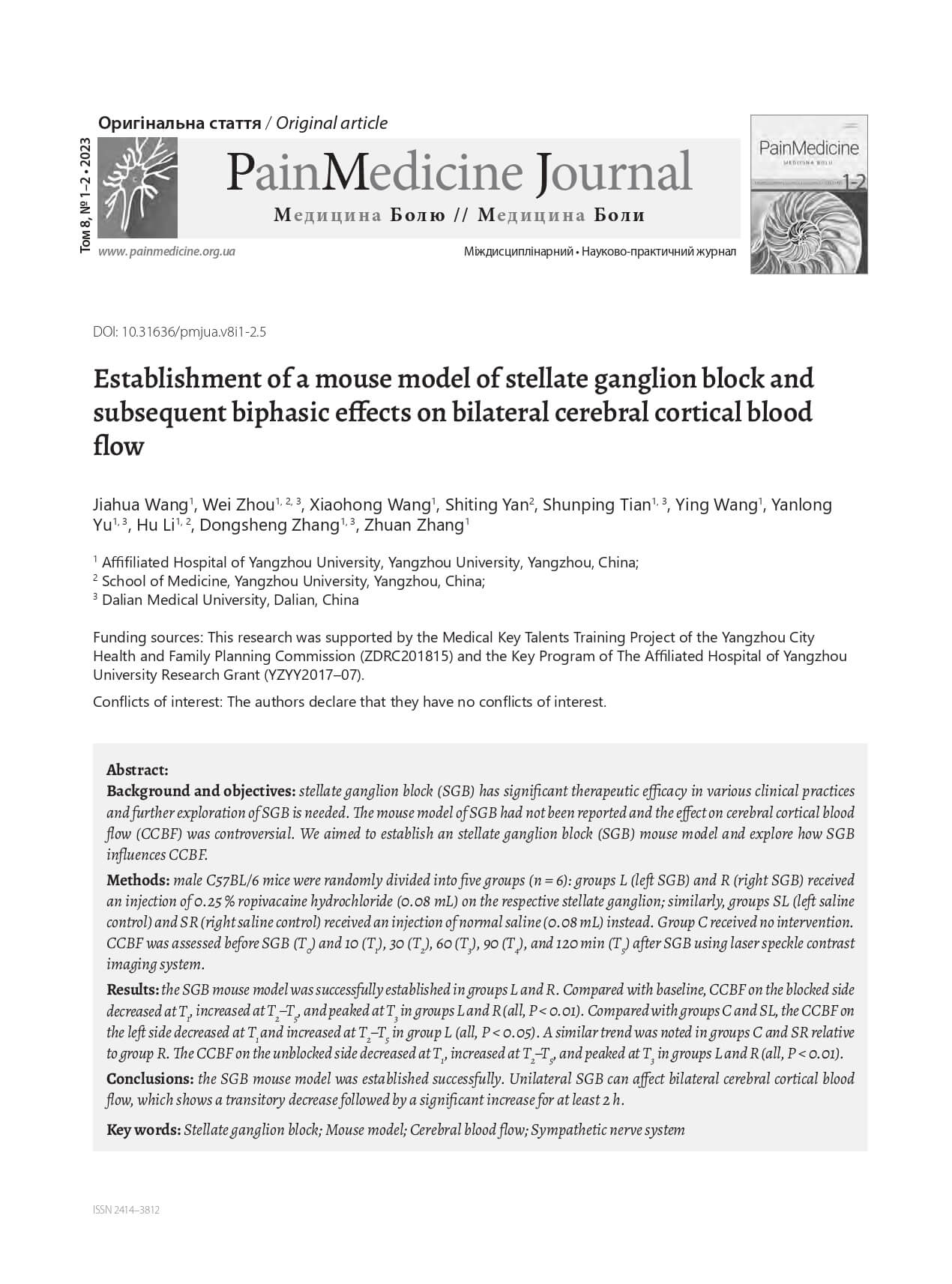
Background and objectives: Stellate ganglion block (SGB) has significant therapeutic efficacy in various clinical practices and further exploration of SGB is needed. The mouse model of SGB had not been reported and the effect on cerebral cortical blood flow (CCBF) was controversial. We aimed to establish an stellate ganglion block (SGB) mouse model and explore how SGB influences CCBF.
Methods: Male C57BL/6 mice were randomly divided into five groups (n = 6): groups L (left SGB) and R (right SGB) received an injection of 0.25% ropivacaine hydrochloride (0.08 mL) on the respective stellate ganglion; similarly, groups SL (left saline control) and SR (right saline control) received an injection of normal saline (0.08 mL) instead. Group C received no intervention. CCBF was assessed before SGB (T0) and 10 (T1), 30 (T2), 60 (T3), 90 (T4), and 120 min (T5) after SGB using laser speckle contrast imaging system.
Results: The SGB mouse model was successfully established in groups L and R. Compared with baseline, CCBF on the blocked side decreased at T1, increased at T2–T5, and peaked at T3 in groups L and R (all, P < 0.01). Compared with groups C and SL, the CCBF on the left side decreased at T1 and increased at T2–T5 in group L (all, P < 0.05). A similar trend was noted in groups C and SR relative to group R. The CCBF on the unblocked side decreased at T1, increased at T2–T5, and peaked at T3 in groups L and R (all, P < 0.01).
Conclusions: The SGB mouse model was established successfully. Unilateral SGB can affect bilateral cerebral cortical blood flow, which shows a transitory decrease followed by a significant increase for at least 2 h.
Downloads
References
Kim YH, Kim SY, Lee YJ, Kim ED. A Prospective, Randomized Cross-Over Trial of T2 Paravertebral Block as a Sympathetic Block in Complex Regional Pain Syndrome. Pain Physician [Internet]. 2019;22(5):E417-E424. Available from: https://pubmed.ncbi.nlm.nih.gov/31561653/
Lipov EG, Joshi JR, Sanders S, Wilcox K, Lipov S, Xie H, et al. Effects of stellate-ganglion block on hot flushes and night awakenings in survivors of breast cancer: a pilot study. The Lancet Oncology [Internet]. 2008 Jun;9(6):523–32. Available from: https://doi.org/10.1016/s1470-2045(08)70131-1
Wu CN, Wu XH, Yu DN, Ma WH, Shen CH, Cao Y. A single-dose of stellate ganglion block for the prevention of postoperative dysrhythmias in patients undergoing thoracoscopic surgery for cancer. European Journal of Anaesthesiology [Internet]. 2020 Apr;37(4):323–31. Available from: https://doi.org/10.1097/eja.0000000000001137
Rae Olmsted KL, Bartoszek M, Mulvaney S, Mc-Lean B, Turabi A, Young R, et al. Effect of Stellate Ganglion Block Treatment on Posttraumatic Stress Disorder Symptoms. JAMA Psychiatry [Internet]. 2020 Feb 1;77(2):130–8. Available from: https://doi.org/10.1001/jamapsychiatry.2019.3474
Abdi S, Yang Z. A Novel Technique for Experimental Stellate Ganglion Block in Rats. Anesthesia & Analgesia [Internet]. 2005 Aug;101(2):561–5. Available from: https://doi.org/10.1213/01.ane.000015 9169.12425.50
Gulcu N, Gonca E, Kocoglu H. A Lateral Percutaneous Technique for Stellate Ganglion Blockade in Rats. Anesthesia & Analgesia [Internet]. 2009 May;108(5):1701–4. Available from: https://doi.org/10.1213/ane.0b013e31819c6018
Ogoh S, Tarumi T. Cerebral blood flow regulation and cognitive function: a role of arterial baroreflex function. The Journal of Physiological Sciences [Internet]. 2019 Aug 23;69(6):813–23. Available from: https://doi.org/10.1007/s12576-019-00704-6
Scherschel K, Bräuninger H, Glufke K, Jungen C, Klöcker N, Meyer C. Location, Dissection, and Analysis of the Murine Stellate Ganglion. Journal of Visualized Experiments [Internet]. 2020 Dec 22;(166). Available from: https://doi.org/10.3791/62026
Zhang J, Nie Y, Pang Q, Zhang X, Wang Q, Tang J. Effects of stellate ganglion block on early brain injury in patients with subarachnoid hemorrhage: a randomised control trial. BMC Anesthesiology [Internet]. 2021 Jan 20;21(1):23. Available from: https://doi.org/10.1186/s12871-020-01215-3
Gupta MM, Bithal PK, Dash HH, Chaturvedi A, Mahajan RP. Effects of stellate ganglion block on cerebral haemodynamics as assessed by transcranial Doppler ultrasonography. British Journal of Anaesthesia [Internet]. 2005 Nov;95(5):669–73. Available from: https://doi.org/10.1093/bja/aei230
Wendel C, Scheibe R, Wagner S, Tangemann W, Henkes H, Ganslandt O, Schiff JH. Decrease of blood flow velocity in the middle cerebral artery after stellate ganglion block following aneurysmal subarachnoid hemorrhage: a potential vasospasm treatment?J Neurosurg [Internet]. 2019 Aug 9:1-7. Available from: https://doi.org/10.3171/2019.5.JNS182890.
Yokoyama K, Kishida T, Sugiyama K. Stellate ganglion block and regional cerebral blood volume and oxygenation. Canadian Journal of Anesthesia/Journal canadien d’anesthésie [Internet]. 2004 May;51(5):515–6. Available from: https://doi.org/10.1007/bf03018319
Treggiari MM, Romand JA, Martin JB, Reverdin A, Rüfenacht DA, de Tribolet N. Cervical Sympathetic Block to Reverse Delayed Ischemic Neurological Deficits After Aneurysmal Subarachnoid Hemorrhage. Stroke [Internet]. 2003 Apr;34(4):961–7. Available from: https://doi.org/10.1161/01.str.0000060 893.72098.80
Tuor UI. Local distribution of the effects of sympathetic stimulation on cerebral blood flow in the rat. Brain Research [Internet]. 1990 Oct;529(1–2):224–31. Available from: https://doi.org/10.1016/0006-8993(90)90831-u
Cassaglia PA, Griffiths RI, Walker AM. Sympathetic Withdrawal Augments Cerebral Blood Flow During Acute Hypercapnia in Sleeping Lambs. Sleep [Internet]. 2008 Dec;31(12):1729–34. Available from: https://doi.org/10.1093/sleep/31.12.1729
Kang CK, Oh ST, Chung RK, Lee H, Park CA, Kim YB, et al. Effect of Stellate Ganglion Block on the Cerebrovascular System. Anesthesiology [Internet]. 2010 Oct 1;113(4):936–44. Available from: https://doi.org/10.1097/aln.0b013e3181ec63f5
Park HM, Kim TW, Choi HG, Yoon KB, Yoon DM. The Change in Regional Cerebral Oxygen Saturation after Stellate Ganglion Block. The Korean Journal of Pain [Internet]. 2010 Jun 30;23(2):142–6. Available from: https://doi.org/10.3344/kjp.2010.23.2.142
Kim EM, Yoon KB, Lee JH, Yoon DM, Kim DH. The effect of oxygen administration on regional cerebral oxygen saturation after stellate ganglion block on the non-blocked side. Pain Physician [Internet]. 2013 Mar-Apr;16(2):117–24. Available from: https://pubmed.ncbi.nlm.nih.gov/23511678/
Jin F, Li X, Tan W, Ma H, Fang B, Tian A, et al. Effects of ultrasound-guided stellate-ganglion block on sleep and regional cerebral oxygen saturation in patients undergoing breast cancer surgery: a randomized, controlled, double-blinded trial. Journal of Clinical Monitoring and Computing [Internet]. 2018;32(5):855–62. Available from: https://doi.org/10.1007/s10877-017-0074-3
Du E, Shen S, Chong SP, Chen N. Multifunctional laser speckle imaging. Biomedical Optics Express [Internet]. 2020 Mar 13;11(4):2007–16. Available from: https://doi.org/10.1364/boe.388856
Durduran T, Burnett MG, Yu G, Zhou C, Furuya D, Yodh AG, et al. Spatiotemporal Quantification of Cerebral Blood Flow during Functional Activation in Rat Somatosensory Cortex using Laser-Speckle Flowmetry. Journal of Cerebral Blood Flow & Metabolism [Internet]. 2004 May;24(5):518–25. Available from: https://doi.org/10.1097/00004647-2004 05000-00005
Stevens RA, Stotz A, Kao TC, Powar M, Burgess S, Kleinman B. The relative increase in skin temperature after stellate ganglion block is predictive of a complete sympathectomy of the hand. Regional Anesthesia and Pain Medicine [Internet]. 1998 May;23(3):266–70. Available from: https://doi.org/10.1016/s1098-7339(98)90053-0.
Downloads
Published
Issue
Section
License
Copyright (c) 2023 Jiahua Wang, Wei Zhou, Xiaohong Wang, Shiting Yan, Shunping Yan, Ying Wang, Yanlong Yu, Hu Li, Dongsheng Zhang, Zhuan Zhang

This work is licensed under a Creative Commons Attribution 4.0 International License.

This work is licensed under a Creative Commons Attribution 4.0 International License