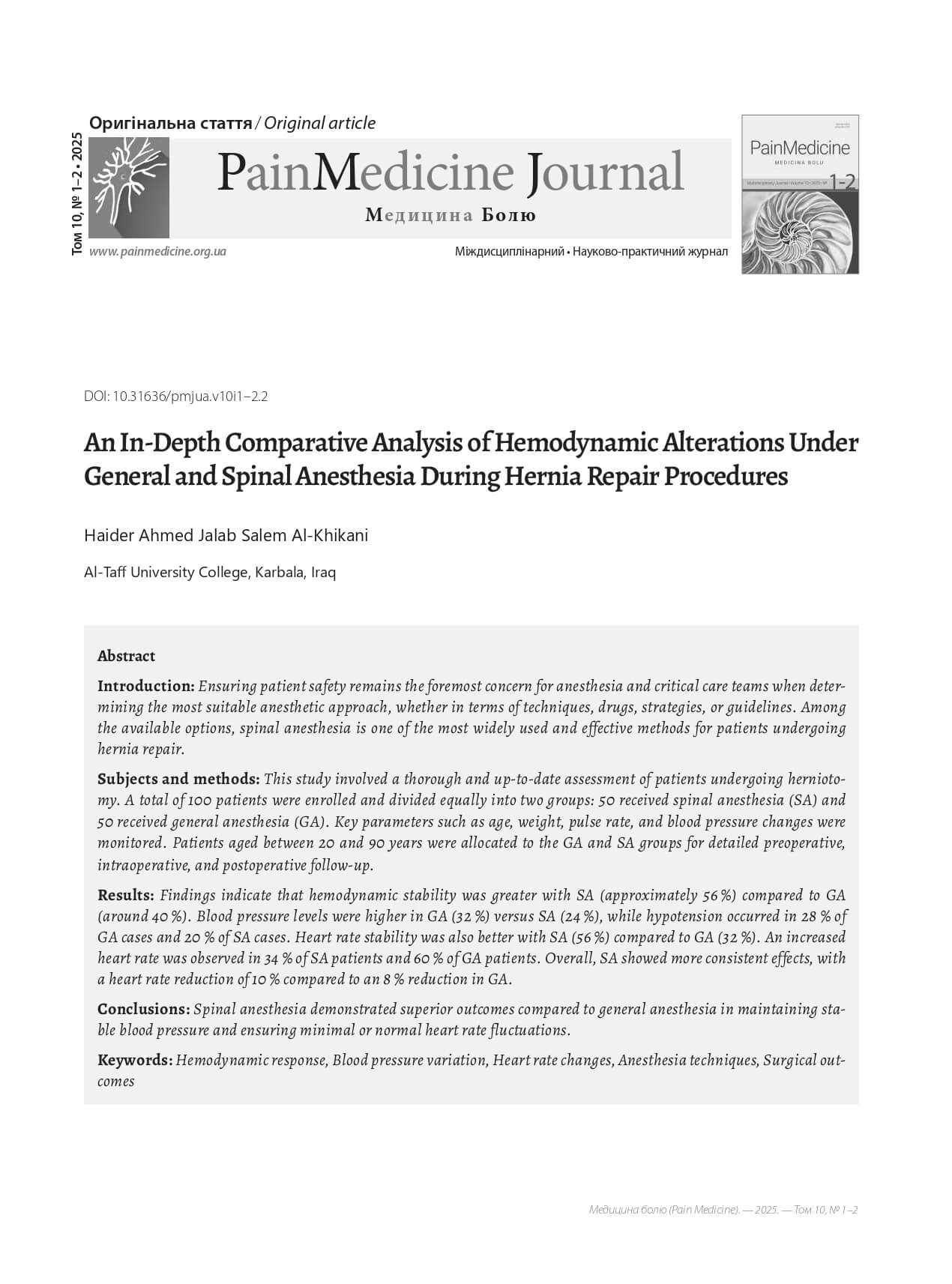
An In-Depth Comparative Analysis of Hemodynamic Alterations Under General and Spinal Anesthesia During Hernia Repair Procedures
DOI:
https://doi.org/10.31636/pmjua.v10i1-2.2Keywords:
Hemodynamic response, Blood pressure variation, Heart rate changes, Anesthesia techniques, surgical outcomesAbstract
Introduction: Ensuring patient safety remains the foremost concern for anesthesia and critical care teams when determining the most suitable anesthetic approach, whether in terms of techniques, drugs, strategies, or guidelines. Among the available options, spinal anesthesia is one of the most widely used and effective methods for patients undergoing hernia repair.
Subjects and methods: This study involved a thorough and up-to-date assessment of patients undergoing herniotomy. A total of 100 patients were enrolled and divided equally into two groups: 50 received spinal anesthesia (SA) and 50 received general anesthesia (GA). Key parameters such as age, weight, pulse rate, and blood pressure changes were monitored. Patients aged between 20 and 90 years were allocated to the GA and SA groups for detailed preoperative, intraoperative, and postoperative follow-up.
Results: Findings indicate that hemodynamic stability was greater with SA (approximately 56 %) compared to GA (around 40 %). Blood pressure levels were higher in GA (32 %) versus SA (24 %), while hypotension occurred in 28 % of GA cases and 20 % of SA cases. Heart rate stability was also better with SA (56 %) compared to GA (32 %). An increased heart rate was observed in 34 % of SA patients and 60 % of GA patients. Overall, SA showed more consistent effects, with a heart rate reduction of 10 % compared to an 8 % reduction in GA.
Conclusions: Spinal anesthesia demonstrated superior outcomes compared to general anesthesia in maintaining stable blood pressure and ensuring minimal or normal heart rate fluctuations.
Downloads
References
1. Callesen T. Inguinal hernia repair: anaesthesia, pain and convalescence. Dan Med Bull. 2003 Aug;50(3):203–18. PMID: 13677240.
2. Chaturvedi S, Lipszyc DH, Licht C, Craig JC, Parekh R. Pharmacological interventions for hypertension in children. Cochrane Database Syst Rev. 2014 Feb 1;(2):CD008117. doi: 10.1002/14651858.CD008117.pub2. PMID: 24488616 .
3. Aglio MDMS, Linda & Urman, Richard. (2017). Anesthesiology: Clinical Case Reviews. 10.1007/978–3-319–50141–3.
4. Forkin KT, Nemergut EC. Miller’s anesthesia, 8th edition [Internet]. American Society of Anesthesiologists; 2016 [cited 2024 Jan 1]. Available from:https://pubHindiyah General Hospitals.asahq.org/anesthesiology/article/124/4/977/14379/Miller-s-Anesthesia-8th-Edition.
5. Wolfsthal SD. Is blood pressure control necessary before surgery? Med Clin North Am. 1993 Mar;77(2):349–63. doi: 10.1016/s0025–7125(16)30256–5. PMID: 8441300.
6. Mabula JB, Chalya PL. Surgical management of inguinal hernias at Bugando Medical Centre in northwestern Tanzania: our experiences in a resource-limited setting. BMC Res Notes. 2012 Oct 25;5:585. doi: 10.1186/1756–0500–5-585. PMID: 23098556; PMCID: PMC3526506.
7. Aitkenhead AR, I Moppett, J Thompson. Smith and Aitkenhead’s Textbook of Anaesthesia. Elsevier Health Sciences; 2013.
8. Butterworth JF. Morgan and mikhail’s clinical anesthesiology. 6th ed. McGraw-Hill Education; 2018.
9. Ti LK, Pua HL, Lee TL. Single vital capacity inhalational anaesthetic induction in adults--isoflurane vs sevoflurane. Can J Anaesth. 1998 Oct;45(10):949–53. doi: 10.1007/BF03012302. PMID: 9836031.
10. Meyler L, Aronson JK. Meyler’s side effects of drugs used in anesthesia. Amsterdam: Elsevier Science; 2009.
11. Kingsnorth A, Leblanc KA, Sanders DL. Management of Abdominal Hernias. Cham: International Publishing; 2018.
12. Cortínez LI, Anderson BJ, Nick, Puga V, Natalia, Hernán Auad, et al. Dexmedetomidine pharmacokinetics in the obese. European Journal of Clinical Pharmacology. 2015 Sep 25;71(12):1501–8.
13. Liem VGB, Hoeks SE, Mol KHJM, Potters JW, Grüne F, Stolker RJ, et al. Postoperative Hypotension after Noncardiac Surgery and the Association with Myocardial Injury. Anesthesiology [Internet]. 2020 May 29;133(3):510–22. Available from: https://pubs.asahq.org/anesthesiology/article/133/3/510/108232/Postoperative-Hypotension-after-Noncardiac-Surgery
14. Kaplan JA, Augustine’s JGT, Manecke GR, et al, eds. Kaplan’s Cardiac Anesthesia for Cardiac and Noncardiac Surgery. 7th ed.Philadelphia, PA: Elsevier; 2017:731–769.L .
15. Pardo M. Miller’s Basics of Anesthesia. Elsevier Health Sciences; 2022.
16. Benes J, Simanova A, Tovarnicka T, Sevcikova S, Kletecka J, Zatloukal J, Pradl R, Chytra I, Kasal E. Continuous non-invasive monitoring improves blood pressure stability in upright position: randomized controlled trial. J Clin Monit Comput. 2015 Feb;29(1):11–7. doi: 10.1007/s10877–014–9586–2. Epub 2014 May 20. PMID: 24841333.
17. Balentine CJ, Meier J, Berger M, Reisch J, Cullum M, Lee SC, Skinner CS, Brown CJ. Using Local Anesthesia for Inguinal Hernia Repair Reduces Complications in Older Patients. J Surg Res. 2021 Feb;258:64–72. doi: 10.1016/j.jss.2020.08.054. Epub 2020 Sep 28. PMID: 33002663; PMCID: PMC7968932.
18. Bay-Nielsen M, Kehlet H. Anaesthesia and post-operative morbidity after elective groin hernia repair: a nation-wide study. Acta Anaesthesiol Scand. 2008 Feb;52(2):169–74. doi: 10.1111/j.1399–6576.2007.01514.x. Epub 2007 Nov 12. PMID: 17999709.
19. Rodgers A, Walker N, Schug S, McKee A, Kehlet H, van Zundert A, Sage D, Futter M, Saville G, Clark T, MacMahon S. Reduction of postoperative mortality and morbidity with epidural or spinal anaesthesia: results from overview of randomised trials. BMJ. 2000 Dec 16;321(7275):1493. doi: 10.1136/bmj.321.7275.1493. PMID: 11118174; PMCID: PMC27550.
20. Reich DL, Hossain S, Krol M, Baez B, Patel P, Bernstein A, Bodian CA. Predictors of hypotension after induction of general anesthesia. Anesth Analg. 2005 Sep;101(3):622–628. doi: 10.1213/01.ANE.0000175214.38450.91. PMID: 16115962.
21. Ramgolam A, Hall GL, Zhang G, Hegarty M, Ungern-Sternberg BS von. Inhalational versus Intravenous Induction of Anesthesia in Children with a High Risk of Perioperative Respiratory Adverse EventsA Randomized Controlled Trial. Anesthesiology: The Journal of the American Society of Anesthesiologists [Internet]. 2018 Jun 1 [cited 2020 Jul 14];128(6):1065–74. Available from: https://anesthesiology.pubs.asahq.org/article.aspx?articleid=2674300
22. Bertrand M, Godet G, Meersschaert K, Brun L, Salcedo E, Coriat P. Should the Angiotensin II Antagonists be Discontinued Before Surgery? Anesthesia & Analgesia. 2001 Jan;92(1):26–30.
23. Boccara G, Ouattara A, Godet G, Dufresne E, Bertrand M, Riou B, et al. Terlipressin Versus Norepinephrine to Correct Refractory Arterial Hypotension after General Anesthesia in Patients Chronically Treated with Renin-Angiotensin System Inhibitors. Anesthesiology. 2003 Jun 1;98(6):1338–44.
24. Augoustides JG, Abrams M, Berkowitz D, Fraker D. Vasopressin for Hemodynamic Rescue in Catecholamine-resistant Vasoplegic Shock after Resection of Massive Pheochromocytoma. Anesthesiology. 2004 Oct;101(4):1022–4.
Downloads
Published
Issue
Section
License
Copyright (c) 2025 HIDER AHMED JULAB

This work is licensed under a Creative Commons Attribution 4.0 International License.

This work is licensed under a Creative Commons Attribution 4.0 International License